DATHHUB
A local-first Jarvis for running life and work from one summonable desktop HUD — persistent AI workspaces, memory, calendar, goals, projects, voice, and explicit control over what agents are allowed to do.
build dathhub --releaseReady Stack resolved in 0.23s
[+] loaded dependency: Tauri 2
[+] loaded dependency: React 19
[+] loaded dependency: TypeScript
[+] loaded dependency: Rust
[+] loaded dependency: Node.js
[+] loaded dependency: Agent SDK
[+] loaded dependency: NeuroVault MCP
[+] loaded dependency: SQLite
[+] loaded dependency: WebSocket
[+] loaded dependency: Whisper + Kokoro00 / What it is.
Most AI assistants are another tab. DATHHUB is the control surface around the work itself: a transparent desktop HUD that appears over any app, opens several independent agent workspaces side by side, and connects them to the same local memory, calendar, goals, projects, and permission system. It is a personal operating system rather than a chat skin — built to make the assistant useful across days without surrendering the machine to it.
01 / One command surface.
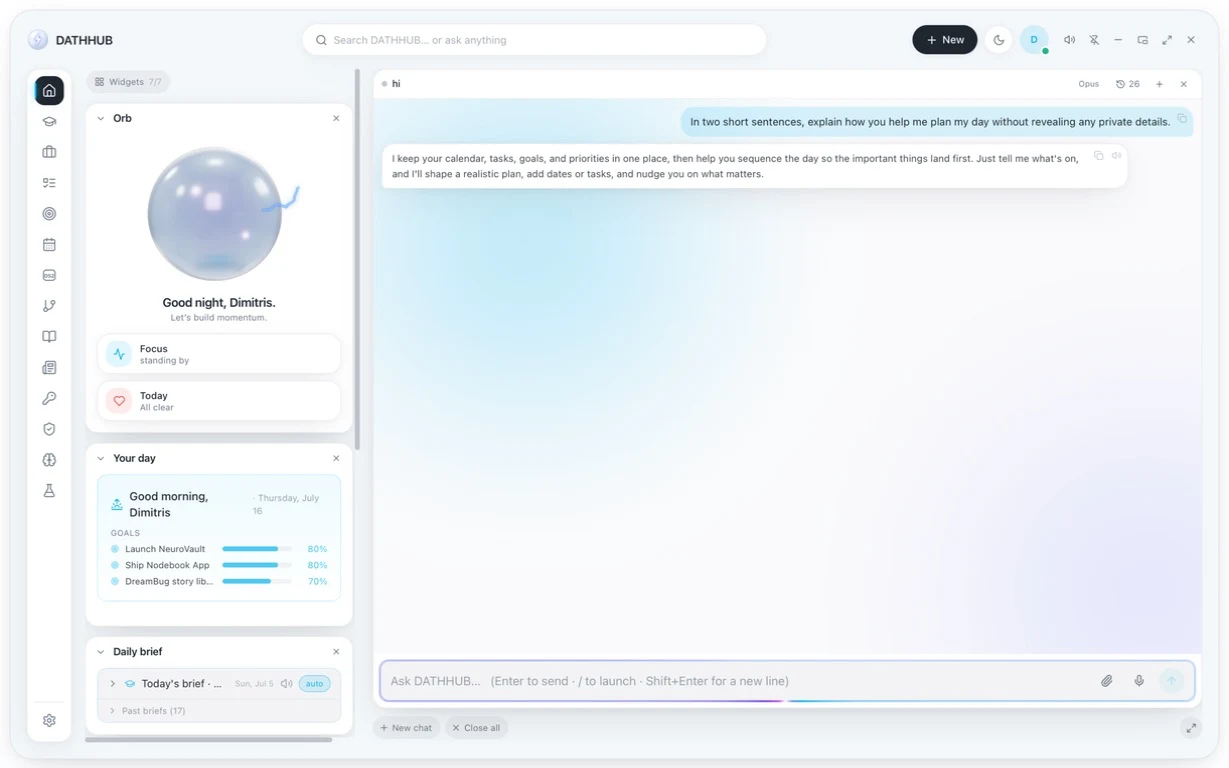
The Home view combines a live agent workspace with a glanceable day dashboard. Every chat is a durable workspace: close the HUD, switch projects, or restart the app and its transcript and agent session remain recoverable.
02 / More than a chat box.
Multiple independent chat panes can run side by side. Each keeps its own transcript, agent session, engine choice, attachments, and compacted memory.
Calendar, goals, tasks, recent VS Code workspaces, open pull requests, briefs, and project state are first-class views instead of context pasted into a chatbot.
NeuroVault provides separate local brains, hybrid retrieval, and inspectable notes over MCP. The HUD can recall context without flattening a life into one giant prompt.
Whisper speech-to-text and Kokoro text-to-speech run on-device. Voice is optional, private, and does not add another usage bill.
03 / Three-layer runtime.
The UI never needs to understand a model provider's raw message stream. A Rust desktop core owns the machine boundary, a Node sidecar owns agent sessions and tools, and the React HUD consumes one small local protocol.
┌────────────────────────────────────────────────────────────┐
│ React HUD · views · widgets · multi-workspace chat         │
└──────────────────────────┬─────────────────────────────────┘
                           │ Tauri IPC + local WebSocket
             ┌─────────────┴─────────────┐
             │                           │
┌────────────▼────────────┐  ┌───────────▼───────────────────┐
│ Rust desktop core       │  │ Node agent sidecar            │
│ hotkey · tray · vault   │  │ sessions · tools · streaming │
│ watchers · Gatekeeper   │  │ calendar · voice · routing   │
└────────────┬────────────┘  └───────────┬───────────────────┘
             │                           │ stdio MCP
             │               ┌───────────▼───────────────────┐
             └───────────────►│ NeuroVault local memory      │
                             │ SQLite · notes · hybrid recall│
                             └───────────────────────────────┘
04 / Permission is a product surface.
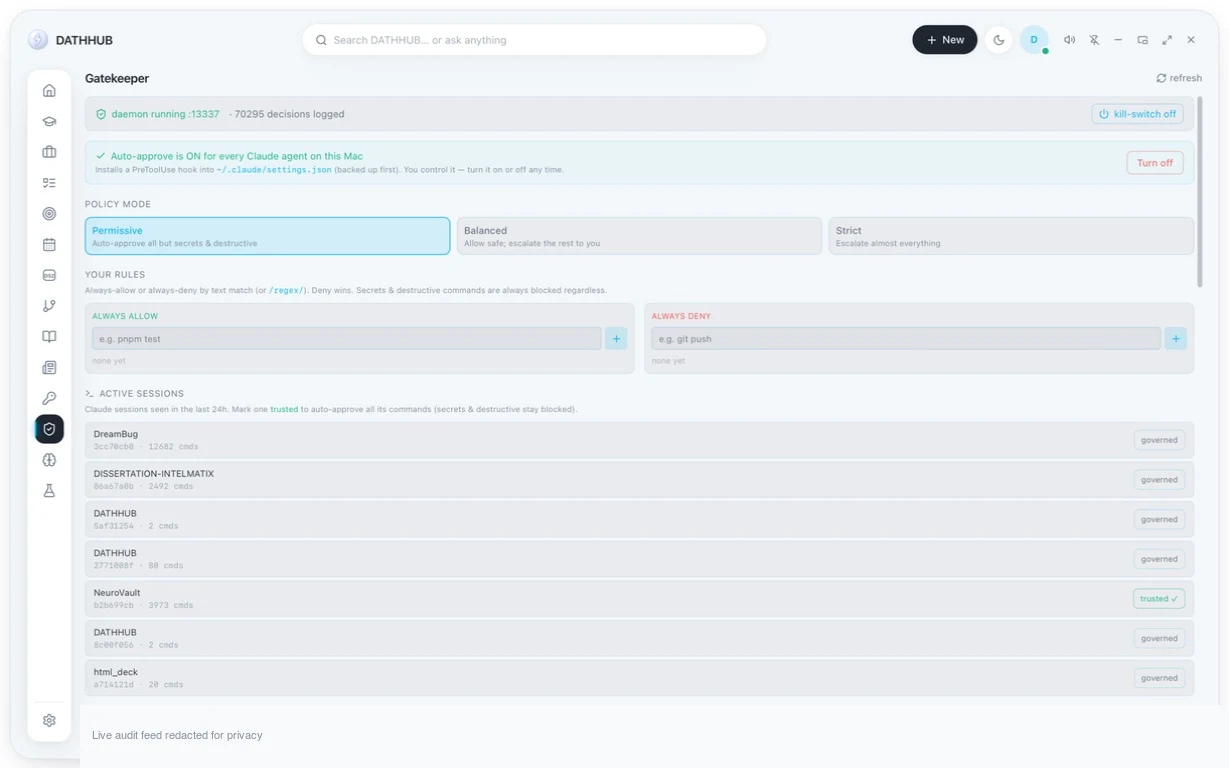
DATHHUB does not reduce safety to “allow everything” or “decline everything.” Gatekeeper applies deterministic secret and destructive-command blocks first, user rules next, then escalates uncertain actions. Its local audit trail and kill switch make autonomy inspectable and reversible.
05 / The constraint that shaped it.
The design brief is deliberately strict: local-first storage, no telemetry, subscription OAuth instead of silent metered API fallback, on-device voice, and human escalation for sensitive actions. Those constraints are not compliance copy added later — they determine the architecture.